
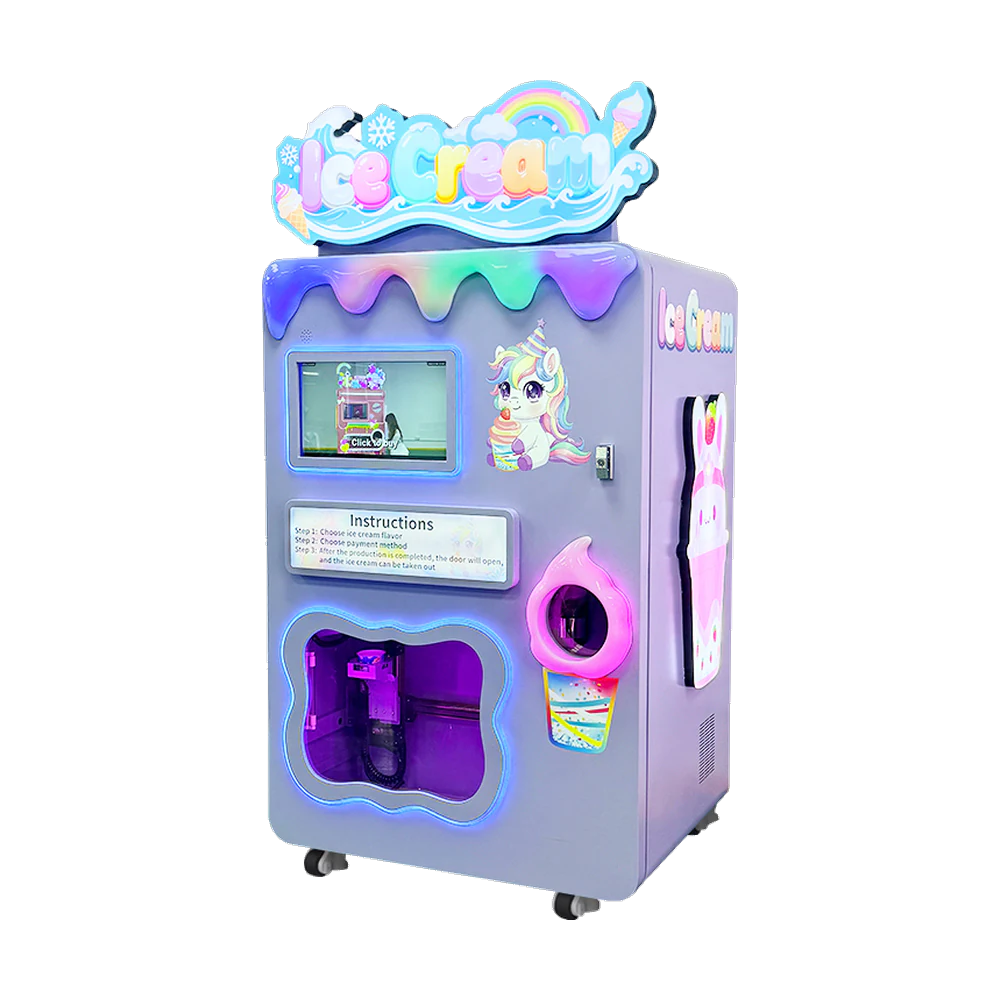
To customers, an ice cream vending machine looks simple: choose a flavor, pay and collect the dessert.
For the buyer, the decision is more complicated. You need to know whether the location has real demand, how often the machine must be refilled and cleaned, which model fits peak traffic, and what support is available when something goes wrong.
Before choosing a machine, answer these seven questions.
1. Does the location have the right customers?
High foot traffic does not automatically mean strong sales.
Ice cream vending machines are generally more suitable for locations with family, student, tourist or entertainment traffic, enough dwell time and a visible position. Examples include shopping malls, cinemas, arcades, scenic areas and event venues.
Observe who passes the machine, when traffic is highest, whether customers are likely to make an impulse dessert purchase, whether the operator can access the machine for service, and whether demand is stable or strongly seasonal. A good location should match both the customer experience and the operating routine.
2. How much capacity do you really need?
Red Rabbit currently offers two automatic ice cream vending machine models.
XG210 is the smaller single-cylinder option. It has 12 L ingredient storage, approximately 144–180 servings per refill and one base flavor with jams and toppings. The current page-listed machine price is USD 5,080.
XG260 is the larger dual-cylinder model. It has 24 L storage, approximately 240–300 servings per refill, two base flavors, three jams and three toppings. Its current page-listed machine price is USD 6,588.
The larger model is not automatically the better investment. A lower-volume venue may not need the extra capacity of XG260. A busy location may lose sales if XG210 requires frequent refilling during peak hours. Choose according to expected demand, available space and refill frequency.
3. Who will refill and clean the machine?
“Self-service” does not mean “maintenance-free.”
An operator still needs to refill ingredients, cups and toppings, check product condition, clean food-contact areas, inspect completed servings, respond to payment or dispensing problems, and record faults and maintenance.
The Red Rabbit product page lists refrigeration, UV sterilization and automatic cleaning functions depending on the model. These features can support daily operation, but they do not replace an agreed cleaning routine or local food-service requirements.
Before ordering, confirm the cleaning steps, required materials, frequency, training and responsible person.
4. Can you detect a problem before customers complain?
Remote management is valuable when the operator is not always at the location.
The XG210 and XG260 pages describe cloud management and remote functions. Buyers should still confirm exactly what the final configuration can display or control.
Ask the supplier to demonstrate sales and inventory information, ingredient or cup alerts, machine status, fault messages, remote settings, user permissions, network requirements and software update procedures. A remote dashboard is useful only when it helps the operator respond faster.
5. Will the machine work in your market?
Payment systems, voltage, interface language and local requirements differ by country.
Do not assume that the standard configuration is ready for your market. Confirm the destination country, voltage and frequency, payment provider and currency, interface language, exterior branding, ingredient and cup supply, and local compliance documents before production.
These items should appear in the final specification or quotation.
6. Is the machine price the total investment?
No.
USD 5,080 for XG210 and USD 6,588 for XG260 are the current prices shown on the Red Rabbit product page. The final project cost may also include freight, import charges, payment hardware, branding and interface changes, ingredients, cups, toppings, venue rent or revenue share, transaction fees, spare parts and destination-specific electrical or regulatory checks. Current machines do not require on-site installation: after delivery, connect the power supply configured for the order and follow the startup guide.
Request an itemized quotation based on the destination, quantity and final configuration. Red Rabbit does not promise a universal profit or payback period because demand and operating costs differ by location.
7. What support will be confirmed in writing?
The machine is only one part of the purchase.
Before paying, ask for written confirmation of the final model and specifications, warranty scope, spare-parts availability, cleaning and operating training, technical-support process, fault-handling responsibilities, shipping documents and market-specific compliance documents.
Clear responsibilities reduce confusion when the machine is already operating overseas.
Which Red Rabbit model should you consider?
Choose XG210 when the location has more limited space or moderate expected demand and one base flavor is sufficient.
Choose XG260 when the venue expects higher peak traffic, needs larger ingredient capacity or wants two base flavors.
The right decision begins with the location, not with choosing the biggest machine.
Frequently asked questions
What is the main difference between XG210 and XG260?
XG210 is a smaller single-cylinder model with 12 L storage and approximately 144–180 servings per refill. XG260 is a larger dual-cylinder model with 24 L storage and approximately 240–300 servings per refill.
How much do the Red Rabbit ice cream vending machines cost?
The current page-listed prices are USD 5,080 for XG210 and USD 6,588 for XG260. Final inclusions, freight and commercial terms require confirmation.
Is an automatic ice cream vending machine maintenance-free?
No. Operators still need to refill ingredients and cups, clean food-contact areas, inspect servings and respond to operational problems.
Can payment, language and branding be configured for the target market?
These requirements can be discussed for the target project, but the final provider, compatibility, scope and price must be confirmed before production.
Send Red Rabbit your destination country, venue type, available space, expected peak demand, payment requirements, interface language and branding needs on WhatsApp. We can then discuss which configuration is more suitable.
Published: 2026-07-30